

Around 2018, the industry hit peak "Microservices Fever." If you weren't deploying 30 Kubernetes containers for a simple e-commerce app, you weren't "web scale." Startups with 500 daily users were adopting architectures designed for Netflix and Uber.
By 2024, the hangover hit hard. Teams were drowning in DevOps complexity, struggling with distributed tracing, and managing "dependency hell" across dozens of repositories.
In 2026, sanity has returned. The architecture of choice for agile, growth-stage companies is the Modular Monolith.
The Fallacy of "Separation of Concerns"
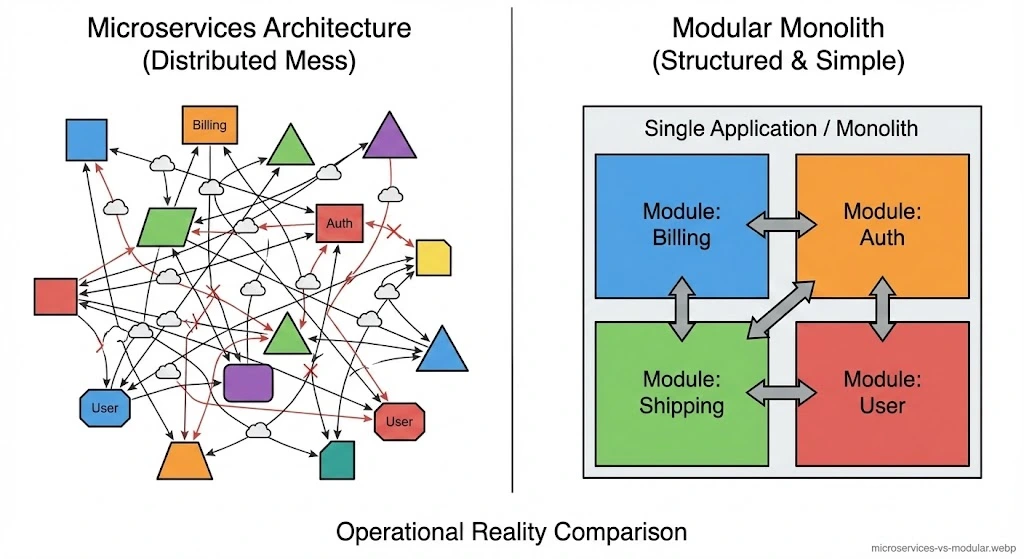
Microservices promise decoupling. In practice, they often create distributed monoliths. You haven't decoupled anything; you've just changed function calls into network calls that can fail, time out, or suffer latency.
The cognitive load shifts from writing business logic to managing infrastructure. Your best developers stop shipping features and start writing YAML files for Kubernetes.
Implementing the Modular Monolith in Laravel
Laravel is uniquely suited for this architecture. We stopped organizing code by type (Controllers, Models, Views) and started organizing by Business Domain.
The Folder Structure Shift
Our `app/` directory no longer holds the whole application. Instead, we have a top-level `modules/` directory:
/modules
  /Billing
    /Models
    /Http/Controllers
    /Database/Migrations
    /BillingServiceProvider.php
  /Catalog
    /Models
    /...
  /Shipping
    /...
Each module has its own Service Provider. The main Laravel app is just a thin shell that boots up these modules. The `Billing` module has no idea the `Shipping` module exists, except through defined events.
The Golden Rule: No Cross-Domain Database Joins
This is the hardest discipline to maintain. The `Shipping` module cannot write a query that joins the `orders` table (owned by Ordering module) with the `shipments` table.
If Shipping needs Order data, it must ask for it via a defined interface, or listen for an `OrderWasPlaced` event and store a local copy of the necessary data. This seems redundant, but it is the key to keeping boundaries clean.
When do you actually need Microservices?
We have a strict rule now. We only extract a module into a microservice if:
- Independent Scaling Needs: For example, our image processing service requires massive CPU/GPU spikes that bog down the main web server. That is a valid microservice.
- Organizational Structure: We have a team of 8 developers working *only* on the Billing API, and their deployment cadence needs to be totally separate from the core product team.
Conclusion
Monolith is not a dirty word. A well-architected modular monolith gives you 90% of the benefits of microservices with 10% of the operational overhead. In 2026, simplicity is the ultimate competitive advantage.