

There is an old saying in software: "Everybody wants automated tests, nobody wants to write them." For years, our team treated testing like flossing teeth—something you do guiltily right before a release (the dentist appointment).
The root cause wasn't laziness. It was friction. The tools we were using felt like they belonged in the Java enterprise world of 2010, not the modern PHP renaissance.
Enter Pest PHP.
The Friction of Verbosity
Look at a standard PHPUnit test. You have to define a class. You have to extend a base class. You have to write methods with specific prefixes. It feels like filling out corporate tax forms.
When a developer wants to quickly test if a user can log in, the mental overhead of setting up that structure often leads to: "I'll just click through the browser to check it manually."
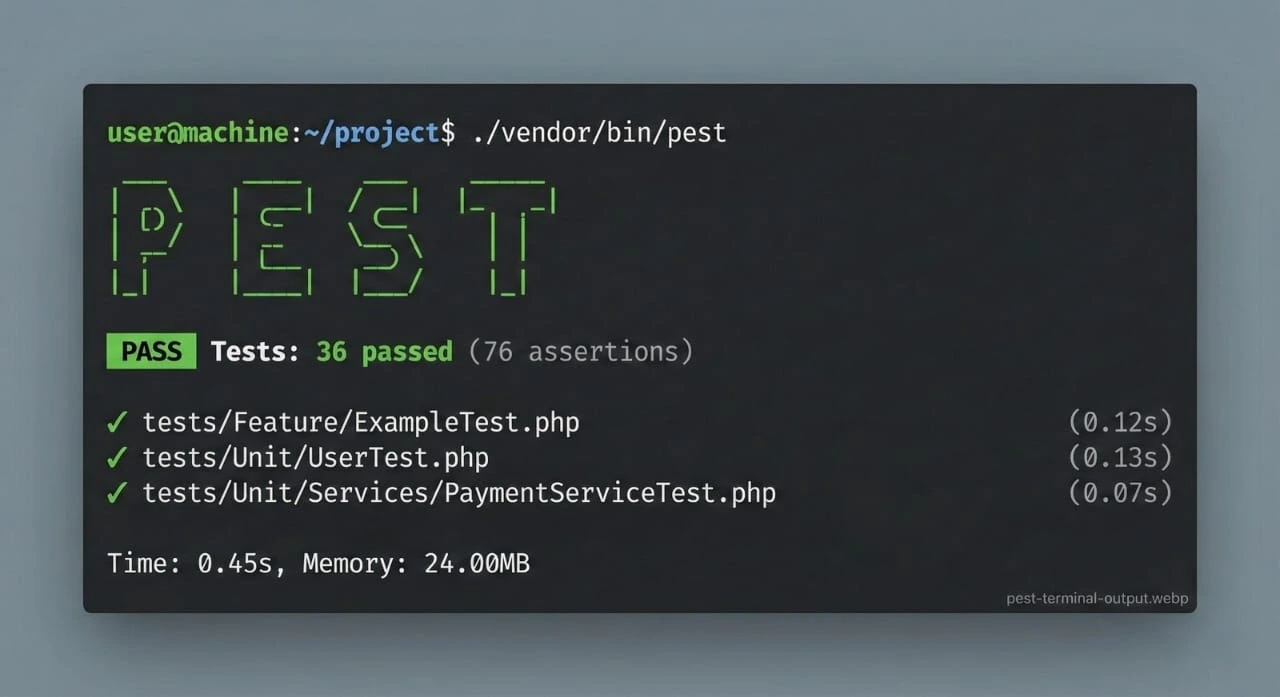
The Joy of "It just reads like English"
Pest removes the ceremony. A test file is just a PHP file with function calls. It focuses entirely on the behavior you are describing.
Feature Spotlight: Higher Order Testing
This is where Pest goes beyond just looking nice. In 2026, we write a lot of tests that just check simple model states or route responses. Pest allows us to chain these together in an incredibly readable way.
The Old Way (PHPUnit):
public function test_unpublished_posts_are_not_visible() {
    $post = Post::factory()->unpublished()->create();
    $response = $this->get('/blog');
    $response->assertOk();
    $response->assertDontSee($post->title);
}
The Pest Way (Higher Order):
test('unpublished posts are not visible')
    ->get('/blog')
    ->assertOk()
    ->assertDontSee(fn () => Post::factory()->unpublished()->create()->title);
It reads like a set of instructions. The cognitive load required to parse what that test does is near zero.
The Game Changer: Architectural Testing
As our team grew, maintaining coding standards became hard. Juniors would sometimes inject Models directly into Controllers instead of using Services, or forget to add type hints.
Pest's Arch plugin allows us to codify these rules into tests that run on every commit:
arch('controllers do not use models directly')
    ->expect('App\Http\Controllers')
    ->not->toUse('App\Models');

arch('all service methods have type hints')
    ->expect('App\Services')
    ->toHaveTypeHints();
This automated code review saved our senior devs countless hours in pull request reviews.
Conclusion
Pest didn't just change our syntax; it lowered the activation energy required to write a test. When testing is easy and even enjoyable, developers write more tests. It's that simple.