

It is the zombie meme of the programming world: "PHP is slow, use Node for scale." In 2015, this was accurate advice. PHP-FPM couldn't handle massive concurrency well, and Node's non-blocking I/O was revolutionary.
But this is 2026. If you are still making architectural decisions based on 2015 data, you are making expensive mistakes.
The Test Scenario: High-Load API Gateway
We have an internal service that acts as an API gateway, routing about 30,000 Requests Per Second (RPS) during peak hours. It does authentication checks, some light JSON transformation, and redis calls.
It was struggling. We decided to benchmark two potential replacements:
- A standard Node.js (Express + Fastify) implementation.
- The existing Laravel application running on Laravel Octane with Swoole and PHP 8.5 with JIT enabled.
The Hardware Setup
Both ran on identical AWS c7g.4xlarge instances (Graviton3 processors, 16 vCPUs, 32GB RAM). We used `wrk2` on a separate machine to generate sustained load.
The Results: Throughput (RPS)
We ramped up connections until latency started to degrade significantly.
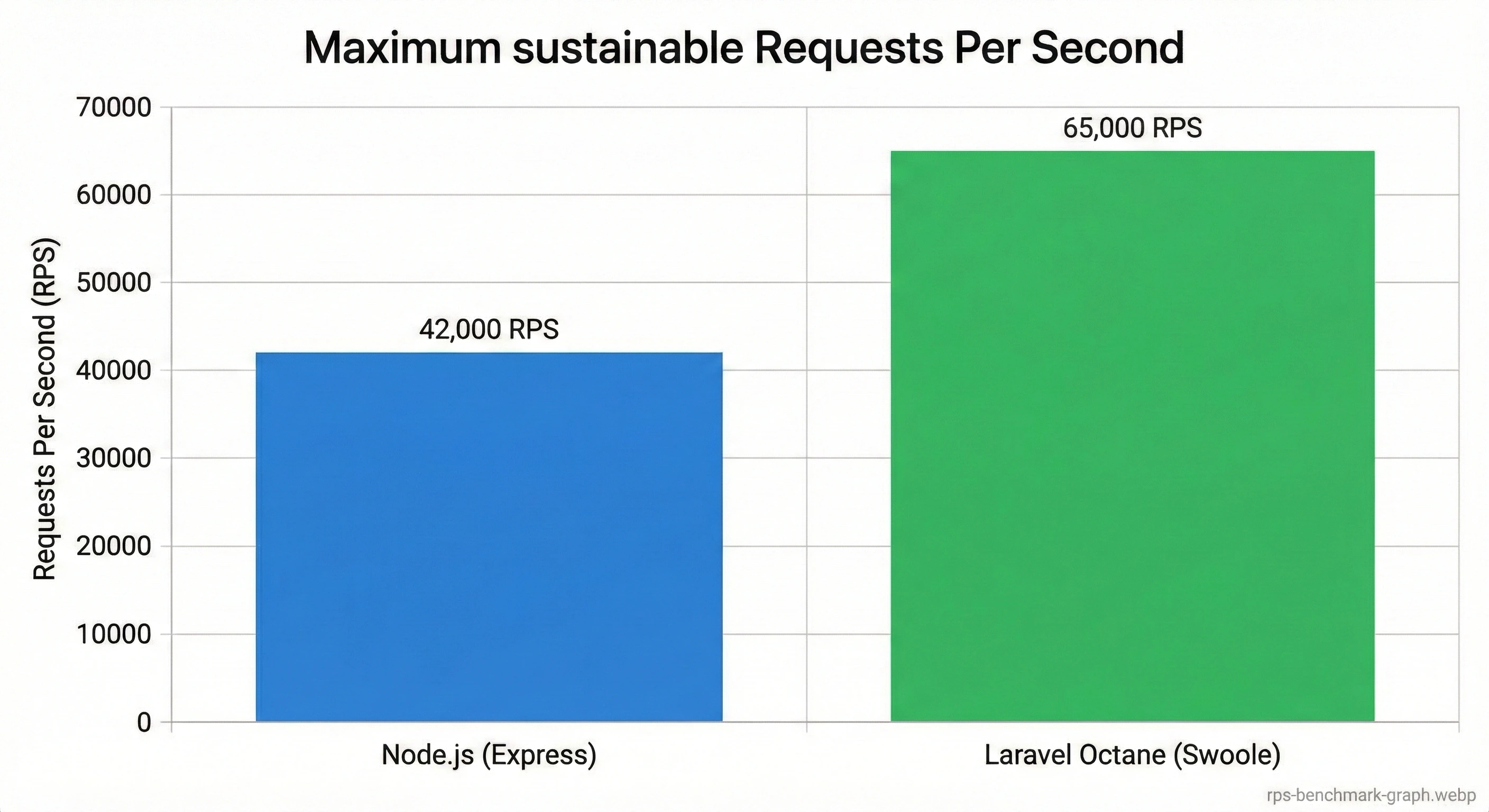
Laravel Octane didn't just match Node; it outperformed it by nearly 50% in raw throughput. How? Because once bootstrapped into memory, PHP's execution model is incredibly streamlined.
The Killer Metric: Latency Distribution (The Node Choke)
Average speed doesn't matter; 99th percentile (p99) latency matters. This is where your users start complaining that the site is "hanging."
Node.js is single-threaded. If one request needs to do some heavy CPU work (like parsing a large JSON body), it blocks the entire event loop. Every other incoming request has to wait.
Swoole (underlying Octane) handles this differently, utilizing co-routines and better worker management to prevent CPU-bound tasks from blocking I/O bound tasks.
| Metric at 40k RPS Load | Node.js (Express) | Laravel Octane (Swoole) |
|---|---|---|
| Avg Latency | 15ms | 8ms |
| p95 Latency | 45ms | 18ms |
| p99 Latency (The killer) | 250ms+ (Spikes) | 35ms (Stable) |
Conclusion: The Modern Backend
The combination of PHP 8.5's mature JIT compiler and the application-in-memory model of Laravel Octane has changed the game. You get the incredible development speed of the Laravel ecosystem without the traditional performance penalty.
Rewriting a mature PHP application into Node/Go just for performance is no longer a justifiable business expense in 2026.