
Let me tell you a quick story. Three years ago, our team sat down to plan our new SaaS dashboard. The mood was tense. We were drowning in a sea of `useEffect` hooks, Redux stores, and API endpoints.
We asked ourselves a dangerous question: "What if we just... didn't use React?"
The "Complexity Trap"
We love JavaScript. But somewhere along the way, we started building Rube Goldberg machines just to display a user's profile picture. We were maintaining two separate apps: a frontend in Next.js and a backend in Laravel.
That meant:
- Double the testing.
- Double the deployment pipelines.
- Double the headache when something broke.
Enter the "TALL" Stack in 2026
When we first tested Laravel Livewire 3.5, it felt like magic. We wrote a PHP function, clicked a button, and the browser updated. No API resources. No JSON parsing. It just worked.
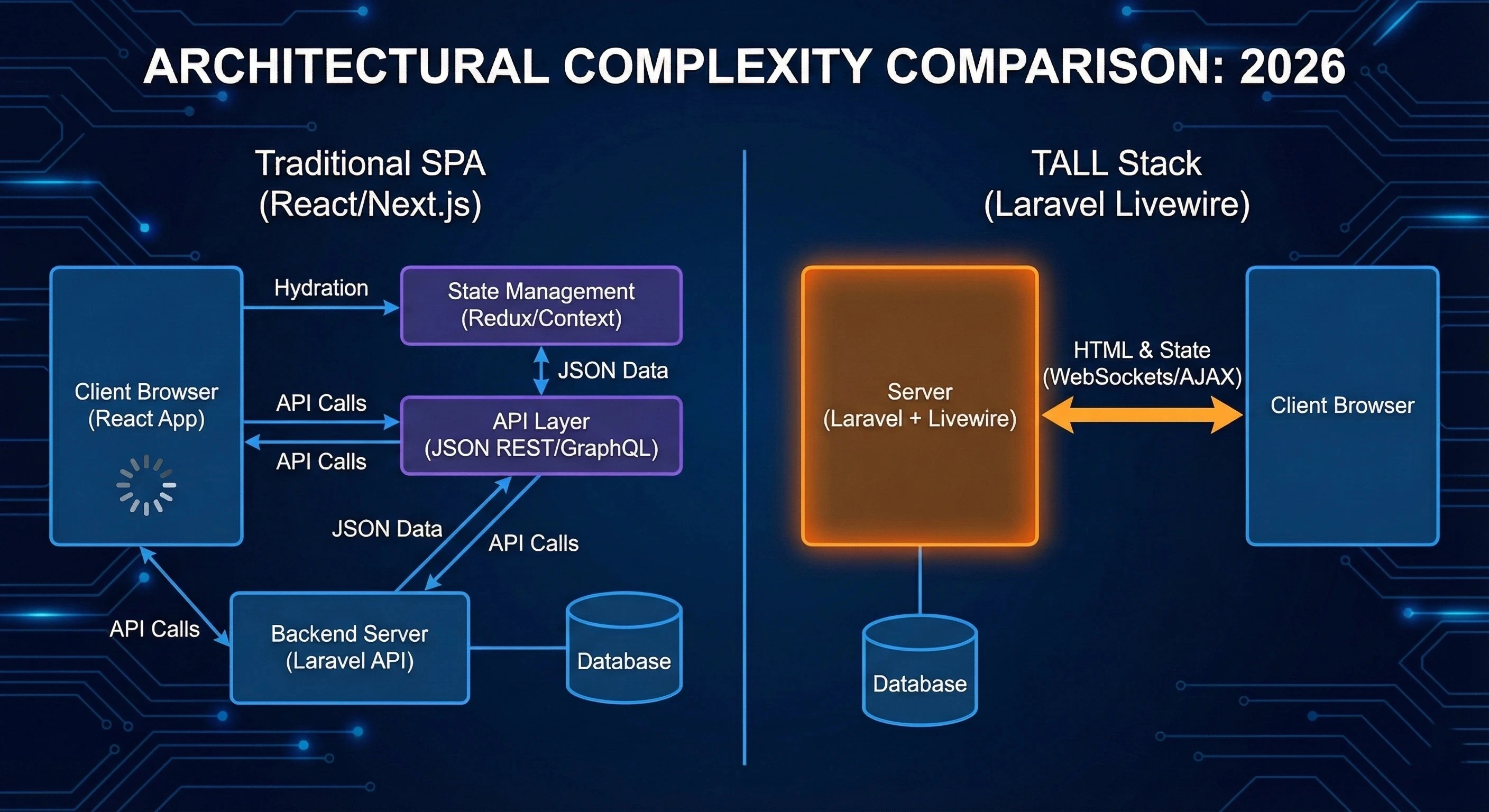
"The best code is the code you don't have to write. Livewire allowed us to delete 40% of our codebase while keeping the same functionality."
But what about "The Feel"?
This was our biggest fear. Would it feel "clunky"? Would it feel like a website from 2010?
The answer is no.
With the new SPA Mode in Laravel, page transitions are instant. To the user, it feels exactly like a React app. But to the server (and to Google), it is just simple, beautiful HTML.
The SEO Impact was Immediate
Within weeks of launching the new version, our Google Search Console numbers started climbing. Why? Because we weren't forcing Google to execute 2MB of JavaScript just to read our H1 tag.
Final Thoughts for Developers
If you are a solo developer or a small team in 2026, stop over-engineering. Your users don't care if you use the latest JS framework. They care if the site is fast and if it works.
For us, that answer is Laravel.